


HVAC Design & Build
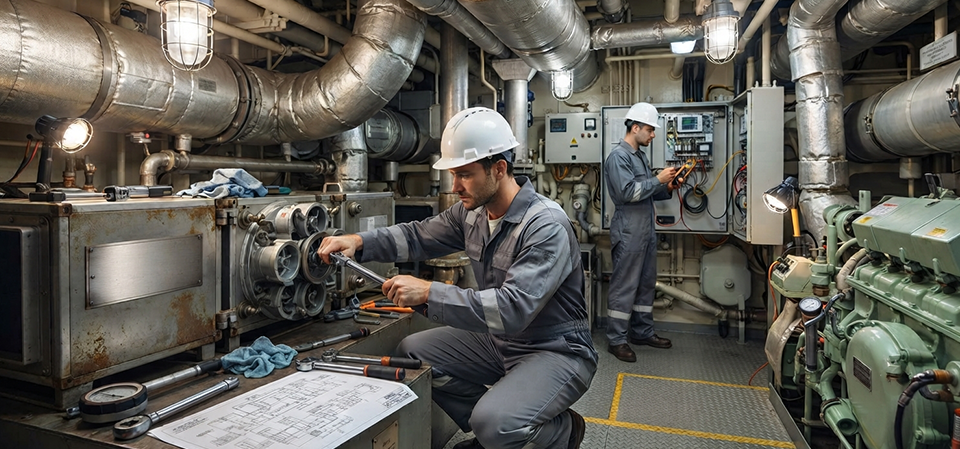
Effective heating, ventilation, and air conditioning serves a purpose that extends well beyond crew or occupant comfort. In many marine and industrial applications, HVAC systems play a critical role in protecting sensitive equipment, maintaining safe working environments in engine rooms and process areas, and controlling humidity levels that can otherwise accelerate corrosion and equipment degradation. Our HVAC design and build service covers the full project lifecycle, from initial design through installation and commissioning.
Why Generic HVAC Solutions Fall Short
Many HVAC challenges on vessels and in industrial facilities stem from applying standard, generic system designs to spaces with distinctly non-standard requirements. Marine applications in particular present space constraints, vibration considerations, and power availability limitations that differ significantly from typical onshore commercial installations. A system designed without accounting for these specific conditions often underperforms — struggling to maintain target temperatures, consuming more energy than necessary, or requiring more frequent maintenance than a properly designed system would need.
Our Design Approach
We begin every HVAC project by assessing the specific thermal, ventilation, and space requirements of the vessel or facility in question, rather than applying a standardized template regardless of the application. This includes evaluating heat loads generated by nearby machinery or process equipment, airflow requirements for maintaining safe working conditions in enclosed spaces, and the physical space and structural constraints that will determine how ductwork and units can realistically be installed.
For engine rooms and machinery spaces specifically, ventilation design needs to account for heat generated by running equipment, ensuring adequate air exchange to maintain safe working temperatures without creating excessive energy demand from oversized systems. For control rooms and spaces housing sensitive electronics, humidity and temperature control take on additional importance, since equipment reliability can be directly affected by environmental conditions that fall outside manufacturer specifications.
Supply and Installation
Once a system design is finalized, we handle the supply and installation of ductwork, units, and controls, working within the physical constraints of the vessel or facility to install the system with minimal disruption to surrounding operations. Our installation team coordinates closely with any concurrent structural or electrical work happening in the same spaces, since HVAC installation frequently overlaps with other renovation or refurbishment work in engine rooms, accommodation spaces, or process areas.
Commissioning and Performance Verification
Installation isn’t the final step — we commission every system we install, verifying that airflow, temperature, and humidity performance meet the design targets established at the outset of the project. This commissioning process often reveals adjustment needs that wouldn’t be apparent from design calculations alone, and addressing them before final handover ensures the system performs as intended from day one, rather than requiring troubleshooting after the project is considered complete.
HVAC for Refit and Refurbishment Projects
Many of our HVAC projects arise as part of broader vessel refit or facility refurbishment work, where existing systems have reached the end of their service life or no longer meet current operational requirements. In these cases, our design work needs to account for the constraints of retrofitting into an existing structure, rather than designing for a blank slate — working around existing ductwork routes, structural members, and space limitations while still delivering a system that performs to modern standards.
Energy Efficiency Considerations
Well-designed HVAC systems offer meaningful energy savings compared to oversized or poorly matched systems, an increasingly important consideration as fuel and energy costs continue to affect operational budgets. We consider energy efficiency throughout our design process, selecting appropriately sized equipment and control strategies that avoid the energy waste common in systems designed without careful load calculation.
Ongoing Support After Installation
Our relationship with a client doesn’t necessarily end at commissioning. We provide ongoing support and servicing for HVAC systems we’ve installed, helping address any performance issues that develop over time and ensuring the system continues to operate efficiently as it ages.
Noise and Vibration Considerations
HVAC systems, particularly in accommodation and control spaces, need to be designed with noise and vibration in mind, since poorly isolated ductwork or units can introduce unwanted noise into spaces where quiet operation matters considerably to occupant comfort and, in control rooms, to clear communication. We account for appropriate vibration isolation and duct design as a standard part of our HVAC planning, rather than treating noise control as an afterthought addressed only if it becomes a problem after installation.
Humidity Control for Equipment Protection
Beyond general comfort, humidity control is often the primary driver behind HVAC requirements in spaces housing sensitive electronics or equipment vulnerable to corrosion. We design humidity control specifications around the actual sensitivity of the equipment being protected, rather than applying generic comfort-oriented humidity targets that may not provide adequate protection for critical control or electronic systems.
In Conclusion
HVAC design and build is a service where getting the underlying engineering right from the outset matters considerably more than simply installing equipment that fits the available space. Our approach — grounded in understanding each vessel or facility’s actual operating conditions rather than applying generic templates — consistently delivers systems that perform reliably, efficiently, and with less need for ongoing troubleshooting than a poorly matched system would require.
Frequently Asked Questions
Do you design HVAC systems specifically for marine environments?
Can you retrofit HVAC into an existing vessel or facility?
Do you offer ongoing support after HVAC installation?
services
download brochure
Please download our document to see specific data’s to our work and services.

Let’s Start Work Together
Sharjah, United Arab Emirates
info@sofiaelectric.com
09.00AM – 18.00PM
