


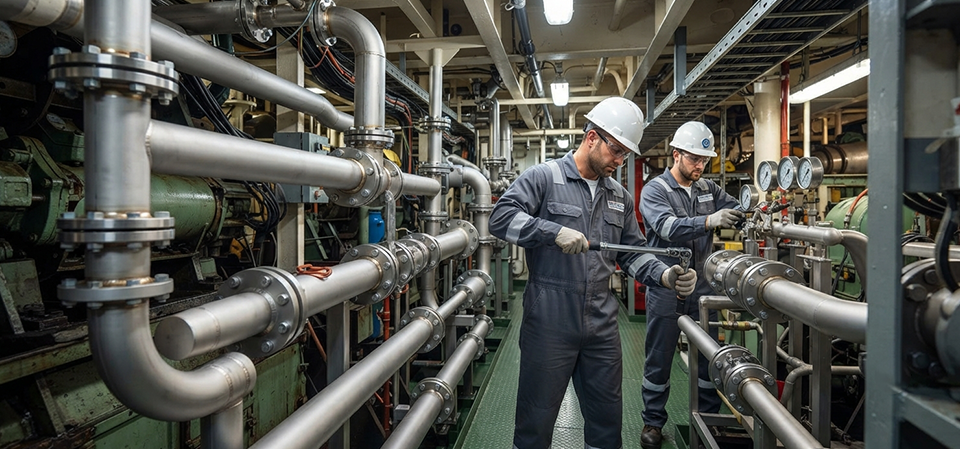
Pipeline Renewals
Piping systems are easy to overlook because they’re rarely visible in the way structural steel or major machinery is — yet they carry ballast water, fuel, cooling water, and process fluids that keep a vessel or facility operating safely. When piping deteriorates, the consequences range from reduced system efficiency to genuine safety hazards, particularly in fuel and high-pressure systems where a failure can have serious operational and environmental consequences.
Why Piping Systems Deteriorate
Piping is subject to a combination of internal and external stresses that accumulate over years of service. Internally, corrosion and erosion from the fluids being carried — particularly seawater, ballast water, and certain process chemicals — gradually thin pipe walls from the inside, often invisibly until a failure occurs. Externally, piping exposed to marine atmosphere faces the same corrosive conditions that affect structural steel, compounded in areas where insulation traps moisture against the pipe surface rather than protecting it. Mechanical stress from vibration, thermal expansion and contraction, and physical damage during maintenance or cargo operations adds further wear over time.
What Our Pipeline Renewal Service Involves
Our approach begins with a condition assessment of the piping system in question, identifying sections showing signs of wastage, leakage, or mechanical damage. Where appropriate, we use thickness testing to quantify wall loss and determine which sections require renewal versus which remain serviceable. Once affected sections are identified, we remove degraded piping and fabricate replacement sections to the correct material specification, wall thickness, and pressure rating — matching original engineering drawings and material certificates wherever possible to maintain full traceability.
Installation follows established procedures for welding, jointing, and support, depending on the piping material and system requirements. Before any renewed section is returned to service, we carry out pressure testing to confirm the integrity of welds and joints under operating conditions, ensuring the renewed piping meets both regulatory requirements and the practical demands of continuous operation.
Coordinating Pipeline Work with Other Repairs
Piping runs are frequently located in the same structural areas as steel requiring renewal — ballast tanks, engine room spaces, and deck areas subject to corrosion often need both structural steel work and piping renewal simultaneously. Because we handle both disciplines in-house, we’re able to sequence this work efficiently, avoiding the delays and coordination difficulties that arise when separate contractors handle structural and piping scopes independently. This integrated approach frequently reduces overall project duration and total vessel or facility downtime compared to managing the two scopes as entirely separate projects.
Material Selection and Compatibility
Choosing the correct replacement material is a critical part of pipeline renewal, particularly given the range of fluids carried by different systems on a typical vessel or industrial site. Fuel lines, ballast systems, cooling systems, and process piping each have different material compatibility requirements, pressure ratings, and regulatory considerations. Using an incorrect material — even one that appears similar — can lead to premature failure or non-compliance with classification and regulatory standards. Our engineering team verifies material specifications against original design documentation and current regulatory requirements before any renewal work begins, ensuring the replacement piping performs correctly for its intended service.
Common Failure Points We Address
Certain areas of piping systems tend to show wear more consistently than others. Elbow and bend sections experience accelerated erosion due to changes in flow direction, making them common candidates for renewal even when straight sections remain in good condition. Sections near flanges and valve connections are prone to corrosion where gaskets and seals can trap moisture. Piping running through ballast tanks or bilge spaces, exposed to standing water and limited ventilation, frequently requires renewal ahead of piping in drier, better-ventilated areas of the vessel or facility.
The Cost of Delaying Pipeline Renewal
Piping failures rarely happen without warning entirely, but the warning signs — a slow leak, a section of visible external corrosion, a drop in system pressure — are easy to dismiss as minor until they progress into a more serious failure. A small leak addressed early is a straightforward, low-cost repair. The same leak, left to worsen, can lead to more extensive pipe wall failure, water ingress into surrounding spaces, or in fuel and process systems, genuine safety and environmental risks that carry far higher costs and consequences than the original repair would have.
Our Commitment to Traceable, Compliant Work
Every pipeline renewal we carry out is documented with full material traceability, giving owners and operators a clear record for their own compliance and audit purposes. Our technicians are experienced in the welding and jointing standards required across different piping materials and system types, and our work is carried out under our ISO 9001:2008 certified quality management process from start to finish.
Working Within Live Operational Environments
Pipeline renewal frequently needs to be carried out while other systems on board or on site remain operational, requiring careful isolation and planning to ensure renewal work doesn’t disrupt systems that aren’t part of the current scope. Our technicians are experienced in planning isolation points, coordinating with a vessel’s own engineering team or a facility’s operations staff, and sequencing work to minimize disruption to systems that need to stay running throughout the project.
Supporting Documentation for Regulatory Compliance
Renewed piping sections come with full documentation — material certificates, weld records, and pressure test results — giving owners and operators the paperwork trail needed for their own regulatory compliance and future reference. This is particularly important for fuel and process piping systems, where regulatory bodies and classification societies expect clear evidence that renewal work was carried out to appropriate standards using correctly specified materials.
In Conclusion
Pipeline renewal may not be the most visible repair work we carry out, but it’s among the most important for maintaining safe, efficient operation. Whether addressing a single section showing early signs of wear or a broader renewal program identified during inspection, our approach combines careful condition assessment, correct material selection, and rigorous testing to ensure every renewed section performs reliably for years of continued service.
Frequently Asked Questions
How do you match replacement piping to the original specification?
Is pressure testing included after pipeline renewal?
Can pipeline renewal be combined with steel renewal work?
services
download brochure
Please download our document to see specific data’s to our work and services.

Let’s Start Work Together
Sharjah, United Arab Emirates
info@sofiaelectric.com
09.00AM – 18.00PM
