


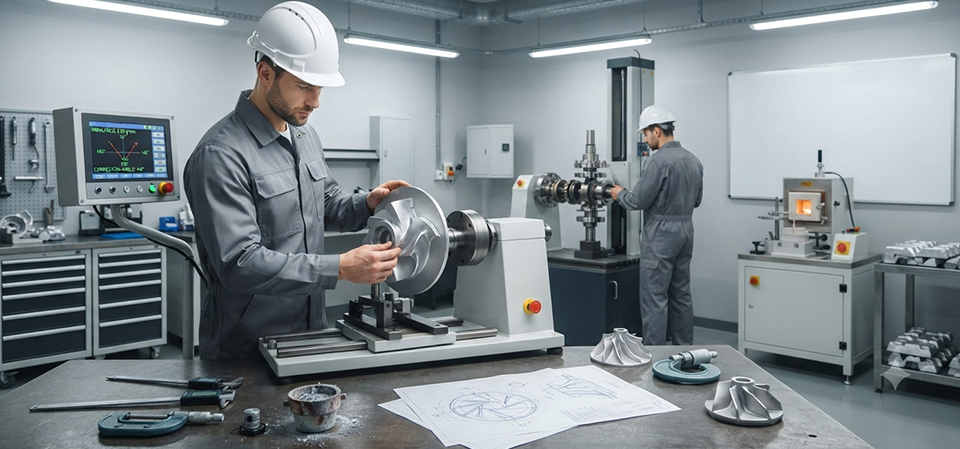
Die Casting & Dynamic Balancing
For components that cannot be economically repaired through machining alone, die casting provides an alternative route to producing replacement parts to the required specification and finish. Alongside this, dynamic balancing addresses one of the most common — and most damaging, if left uncorrected — issues affecting rotating equipment: imbalance, which accelerates wear and can lead to eventual catastrophic failure if not properly addressed.
Die Casting: An Alternative to Machining
While our machining and lathe capability handles a significant portion of the components requiring manufacture or restoration, some components are better suited to production through die casting, particularly where complex geometries or specific material properties make machining from solid stock impractical or prohibitively expensive. Our die casting service provides an alternative production route for these components, delivering parts that meet the required dimensional specification and surface finish for their intended application.
When Die Casting Makes Sense
Die casting is generally the more practical choice for components with complex shapes that would require extensive machining work to produce from solid material, or for components where the material properties achieved through casting — such as specific strength or wear characteristics — better suit the application than machined alternatives. Our team assesses each component requirement individually to determine whether machining or die casting represents the more efficient, cost-effective production method for that specific part.
Understanding Rotating Equipment Imbalance
Imbalance occurs when the mass distribution of a rotating component isn’t evenly centered around its axis of rotation, causing the component to generate vibration as it spins. This vibration doesn’t stay contained to the imbalanced component itself — it transmits through bearings, mounting structures, and connected equipment, accelerating wear throughout the entire system. Left uncorrected, imbalance-induced vibration leads to progressively faster bearing wear, loosening of fasteners and connections, and eventually, fatigue failure of the rotating component or surrounding structure.
Common Sources of Imbalance
Imbalance can develop for several reasons over the life of a rotating component. Material wear or erosion that removes mass unevenly from a component’s surface is a common cause, particularly in pump impellers exposed to abrasive or corrosive fluids. Damage from foreign object contact, buildup of deposits on one side of a component, or manufacturing defects in a replacement part can all introduce imbalance that wasn’t present when the equipment was originally installed.
Our Dynamic Balancing Process
We balance impellers, rotors, fans, and other rotating components using precision balancing equipment that identifies exactly where and how much mass needs to be added or removed to bring the component within acceptable balance tolerances for its specific application and operating speed. This process typically involves spinning the component at controlled speeds while measuring vibration at multiple points, allowing our technicians to precisely calculate the correction needed rather than relying on estimation or trial and error.
Verifying Results Through Testing
Balancing isn’t considered complete until we’ve verified the results through post-balancing testing, confirming that vibration levels fall within acceptable limits before the component is returned to service. This verification step matters because balancing work that isn’t properly confirmed can leave a component only partially corrected, providing a false sense of resolution while the underlying vibration issue continues to cause accelerated wear.
Balancing as Part of Broader Repair Work
Dynamic balancing frequently forms part of a larger repair scope rather than standing alone as an isolated service. A pump impeller replaced as part of a machinery overhaul, for example, typically requires balancing before installation to ensure it doesn’t introduce new vibration issues into an otherwise properly repaired system. Because we offer balancing alongside our machinery and motor overhauling services, this step is built into our broader repair process rather than requiring coordination with a separate external provider.
The Cost of Skipping Balancing
Some repair providers treat balancing as an optional add-on rather than a standard part of rotating equipment repair, which can leave clients with equipment that appears fully repaired but continues to suffer accelerated wear due to unaddressed imbalance. We consider balancing a standard, integral part of any repair involving rotating components where imbalance is a realistic risk, rather than an optional extra that clients need to specifically request.
Balancing Tolerances for Different Applications
Different rotating equipment applications require different balancing tolerances, depending on operating speed, the equipment’s sensitivity to vibration, and the consequences of imbalance in that specific application. High-speed rotating components generally require tighter balancing tolerances than slower-speed equipment, since vibration forces increase significantly with rotational speed. Our balancing process accounts for these application-specific requirements rather than applying a single generic tolerance regardless of the equipment’s actual operating conditions.
Preventing Recurrence Through Root Cause Awareness
Where imbalance is identified as a recurring issue on a particular piece of equipment, we investigate the underlying cause rather than simply rebalancing repeatedly without addressing why the imbalance keeps developing. This might reveal an abrasive process fluid causing uneven wear, a misalignment issue introducing stress that manifests as imbalance, or a component reaching the end of its practical service life — insights that help clients address the actual problem rather than treating symptoms indefinitely.
In Conclusion
Die casting and dynamic balancing might operate somewhat behind the scenes compared to more visible repair services, but both play a genuinely important role in ensuring repaired and replaced components perform reliably over the long term. Our approach treats these as standard, integrated parts of our broader repair process, helping prevent the kind of accelerated wear that comes from unaddressed imbalance or poorly produced replacement components.
Frequently Asked Questions
When is die casting used instead of machining?
Why does dynamic balancing matter for rotating equipment?
Is balancing verified with testing after the work is done?
services
download brochure
Please download our document to see specific data’s to our work and services.

Let’s Start Work Together
Sharjah, United Arab Emirates
info@sofiaelectric.com
09.00AM – 18.00PM
